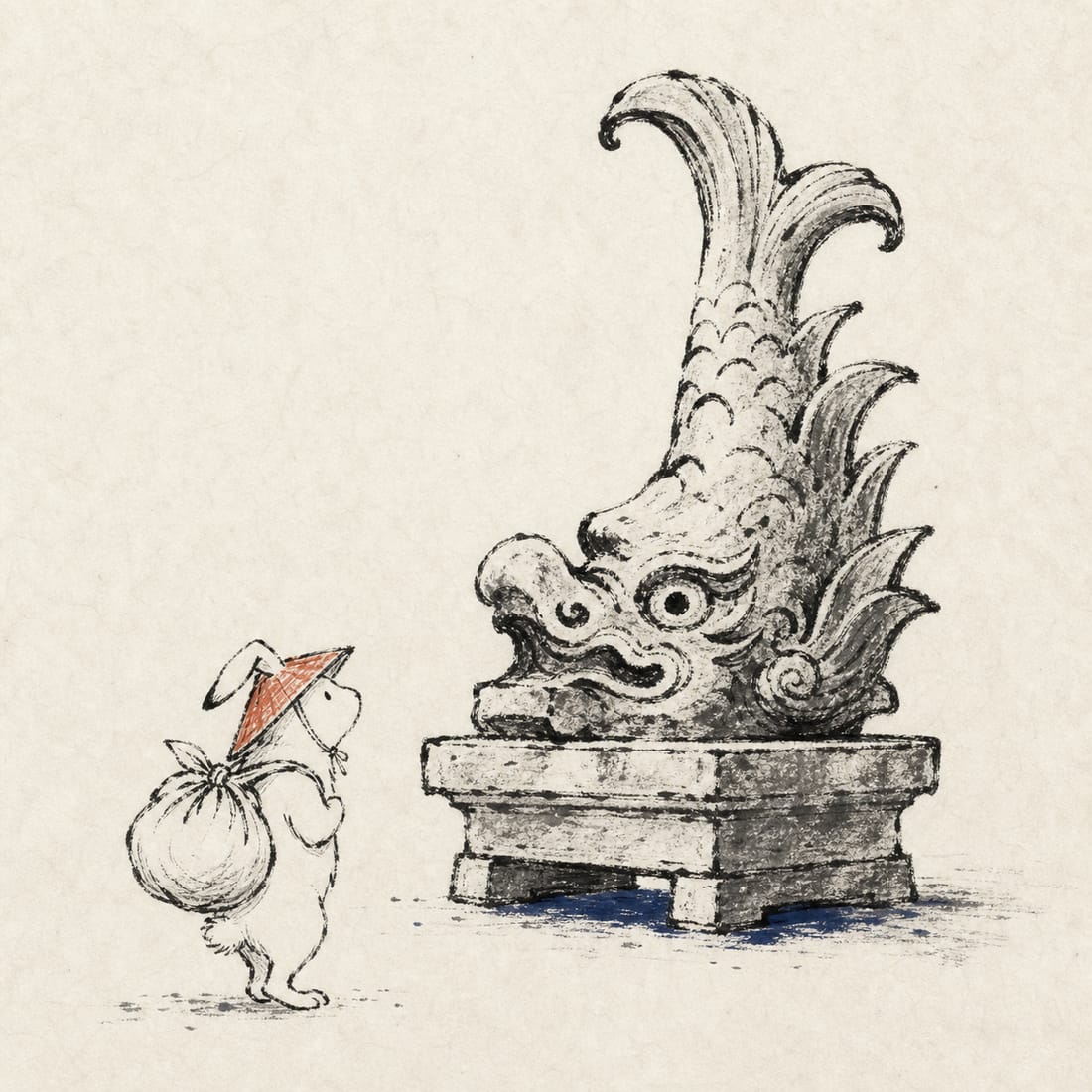
After all the talk of ogres and master swords, let’s step back to a much older age. At about the same time the capital of Heijō-kyō stood at Nara, a fine temple had already been built at the foot of Mt. Daisen. The place is the Ōtono district of Hōki Town — around the grounds of present-day Fukuju-ji temple.
A temple complex stood here in the Hakuhō era
Excavations have uncovered the shinso (the foundation stone that holds the central pillar of a pagoda), along with traces of the main hall and the cloister. The period is the Hakuhō era, the latter half of the 7th century. In other words, “at almost the same time as the capital at Nara, there was a power at the foot of Mt. Daisen capable of building a temple complex on this scale.” It is proof that the local clans here held that much strength.
Even the place name, Ōtono (“great hall”), hints that something large once stood here.
A stone shachihoko — one of only three in the country
What was unearthed from this temple site is the stone shibi (sekisei shibi).
A shibi is the ornament set at each end of a temple roof. It was a charm against fire, and it is the ancestor of the shachihoko that would later crown Japanese castles. Most are made of clay tile, but the one here is carved from stone. It stands about one meter tall, 45 centimeters wide, with ten ridged steps. It is designated an Important Cultural Property of Japan.
And here is the surprising part: only three stone shibi survive in all of Japan — two at the Sannō Haiji site in Gunma, and this one at Ōdera Haiji. That is why Hōki Town calls itself “the home of the shibi.”
If you go to see it
- Ōdera Haiji site — traces such as the pagoda foundation stone remain. Find the place on the map
- As another cultural property of the town, on the right bank of the Hino River stands the Yatagai Residence (a Registered Tangible Cultural Property — the old home of a family that ran a landholding and brewing business). It makes for a good day of visiting old things.
A word from the rabbit: That shachihoko shining on top of a castle keep — to think its ancestor was this close by. And made of stone, no less. It must have been heavy.
References:
- Hōki Town tourism site, “The pagoda foundation and stone shibi of Ōdera Haiji”
- Tottori Cultural Properties Navi, “Stone shibi”
- ※ The dating and designation follow published, historical sources.